A drone-powered aerial view of the Middleton Railway Museum
Although Nova Scotia once had an extensive rail network, there are very few visible sections left to see unless you are in the corridor running between Halifax/Dartmouth and Montreal.
The Middleton Railway Museum is one of the small number of remaining train stations.
The Gaspereau River stretches about 24 km, flowing from Gaspereau Lake on South Mountain, just south of Kentville, to its mouth at Hortonville on the Minas Basin. The lower 6.5 km is tidal up to Melanson, with wide tidal marshes along its lower stretches. The upper 16 km moves quickly over gravel beds, boulders, and bedrock, except for a few dammed spots that create narrow, deep channels.
Damming for hydroelectric power has linked twelve major lakes to the river, forming a watershed of 1,375 square kilometres. One key tributary is the Black River, which meets the Gaspereau at White Rock. The Black River once flowed farther north into the Cornwallis River but was redirected to the Gaspereau through a natural erosion process called river capture.
About 3.2 kilometers from the Grand-Pré National Historic Site’s Visitor Centre, the Deportation Cross at Horton Landing stands as a moving tribute to the forced deportation of 2000 Acadians from Grand-Pré in 1755.
Designed by René-Arthur Fréchet, the Gothic-style cross was constructed by Abrams and Son of Moncton and installed by Thaddée Léger of Lewisville in 1924. Made of malleable iron and standing about 4 meters tall, it features an inscription recounting the deportation, marking the site where Acadians were forcibly taken aboard ships.
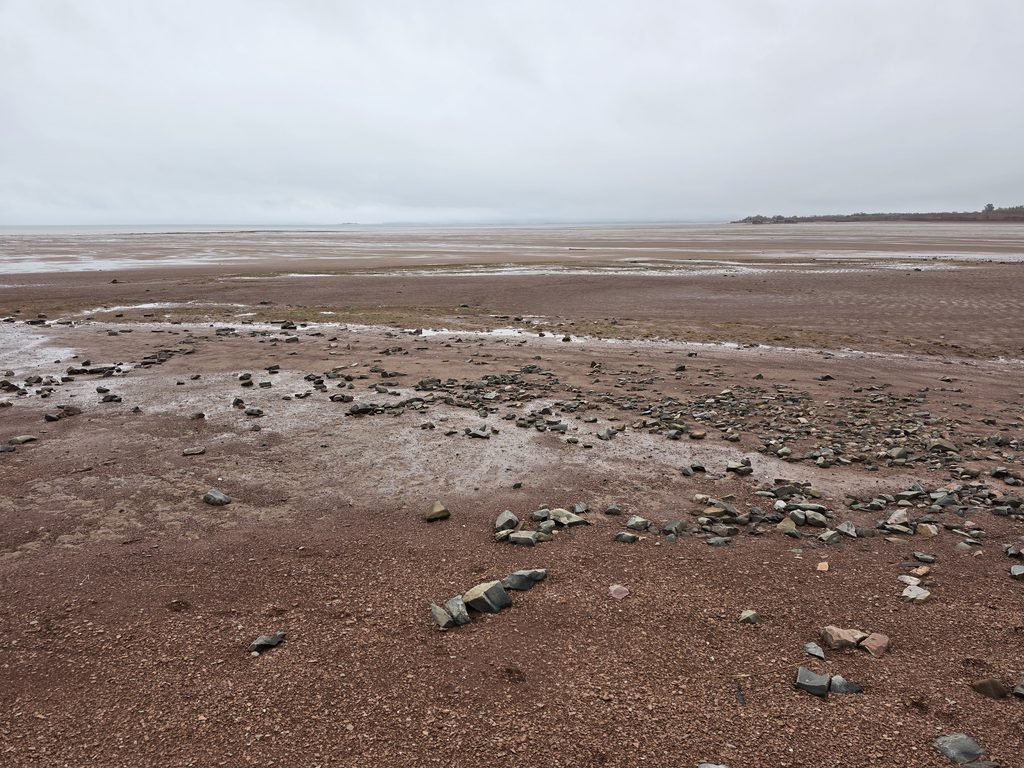
The dry bed of the creek which is in sight, a few paces in the marsh is the spot where the VICTIMS OF THE EXPULSION OF THE ACADIANS OF 1755 were embarked on the small boats to be rowed over to the transports lying at anchor in Minas Basin.
In 1924, the Dominion Atlantic Railway deeded a plot of land beside the tracks at Hortonville to the Acadian Memorial Society to erect an iron memorial cross at what was believed to be the site of the deportation. In 2005 the railway assisted in moving the cross to a site owned by Parks Canada, closer to the river, in a location established by more recent research as the actual deportation site.
The wide, open tidal estuary of the Gaspereaux River at Horton Landing called for major bridgework. Finishing this bridge was one of the last hurdles for the Windsor and Annapolis Railway, which began operating in August 1869, aside from the missing link between the Gaspereaux and Avon Rivers at mile 44.5 on the Halifax Subdivision between Avonport and Horton Landing.
The first bridge was described by W. W. Clarke as a covered railway bridge. Additional bridge work was started in 1871 and was completed in 1872.The last of several DAR bridges over the Gaspereaux was built for the DAR in 1911 by the W.R. McNeil Company of New Glasgow, NS. The bridge consists of two high deck plate girder spans, two steel through truss spans and 89 feet of standard piles.
Forget-Me-Nots are one of the most common and popular flowers to add to a garden. They’re beautiful, smell lovely, and are relatively easy to care for. Perfect for me!
The Nova Scotia Museum of Natural History features a female blue lobster, which is a rare and unique specimen. This blue lobster is part of the museum’s collection and is a testament to the diversity of marine life in Nova Scotia.
Visitors can learn about the blue lobster’s genetic mutation that results in its distinctive blue coloration and its significance in the museum’s exhibits. The blue lobster is not only a rare find but also a symbol of the museum’s commitment to preserving and showcasing the natural heritage of the region.
Gus is a 103-year-old gopher tortoise living at the Nova Scotia Museum of Natural History and is considered to be an icon of Halifax. He is believed to be the world’s oldest living gopher tortoise.
Gus can be found on supervised walks through the museum halls, and is no longer allowed to be touched by visitors. During nice weather, Gus will roam in the backyard of the museum. His favourite foods are blueberries, bananas, and romaine lettuce. He also loves grasses and clovers, as well as fresh dandelions.
Gus received his name in 1952. He is named after John Augustus Gilhen, who devoted his time to helping at the museum throughout the 1950s. Gus had a particular fondness for Gilhen, who would give him snacks.