
Did you know that Strathcona Provincial Park is home to mining operations that produce zinc, copper, gold and silver? The road into Strathcona-Westmin Provincial Park goes right beside the mine operation.

The Boliden Westmin Mine is relatively unique in that it is surrounded by a Class A park and the boundary of its mineral claims fall entirely within the Strathcona-Westmin Class B Park. All mining activities, and the eventual reclamation and rehabilitation of the site, fall under a park-use permit.

Prospecting in the volcanic rocks of the Sicker Group has taken place at the south end of Buttle Lake since 1917. Sporadic exploration continued until 1961 when Western Mines instituted a program of trenching, tunnelling and diamond drilling that led to the development of the Lynx Mine open-pit in 1966. Underground production began at the Lynx Mine in 1968, and then at the Myra Mine in 1972. The Lynx open pit and the Myra and Lynx underground mines are now closed.

In 1979 an ore deposit was located in a different rock horizon 350 metres below the bottom of Myra Creek valley. In 1985 the HW mine and the Battle-Gap mine started production, and is currently the main source of ore. Both current mines produce polymetallic ore and are serviced from a single production shaft at the 700m level. The two operations are linked by a 1.8km-long adit.

The main production method in the H-W mine is sub-level stoping with longhole drilling, while sub-level stoping and drift-and-fill are used at Battle-Gap. Mined ore is hauled to an underground crusher and hoisted crushed ore is taken to the mill about 1km from the shaft.
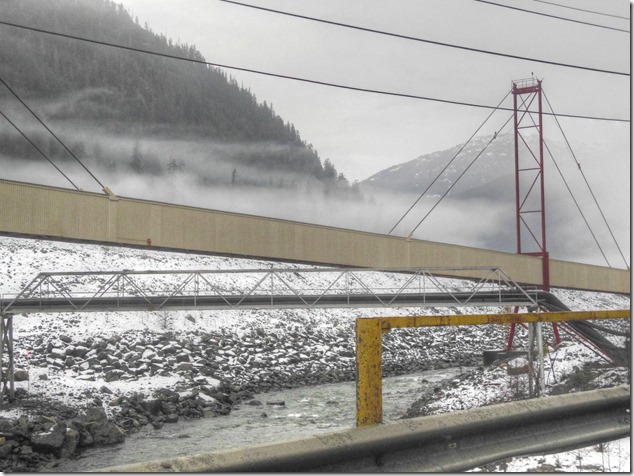
Myra Falls uses conventional flotation technology to recover sulphide concentrates. The current mill was commissioned in 1985 and has been progressively modernised since then. In 1990, the copper and zinc flotation circuit was streamlined by adding column flotation cells and reducing the recirculation load to improve zinc recovery. In 1992, a Knelson gravity concentrator was added to each grinding circuit to improve gold recovery.

Ore concentrates are processed on site in a mill, transported to Campbell River, and then shipped to overseas smelters, typically in Japan and Korea.
and now you know…
[fbalbum url=”https://www.facebook.com/media/set/?set=a.291972514259800.1073742095.123247217798998&type=3″ size=”187″]