
In 1908 a Canadian/United States treaty was created, providing for the complete demarcation of the boundary from Atlantic to Pacific and the preparation of accurate modern charts throughout. Although the land sections of the boundary had been marked by monuments, mounds or rock cairns, the water boundary had previously been marked on charts only as a curved line through the various rivers and lakes on its course.
In the treaty of 1908 provision was made to suitably mark the water boundary by buoys, monuments, and ranges and in such other ways. The terms of the treaty were to be carried out on each of the various sections of the boundary under the direction of two Commissioners, one to be appointed by each country.
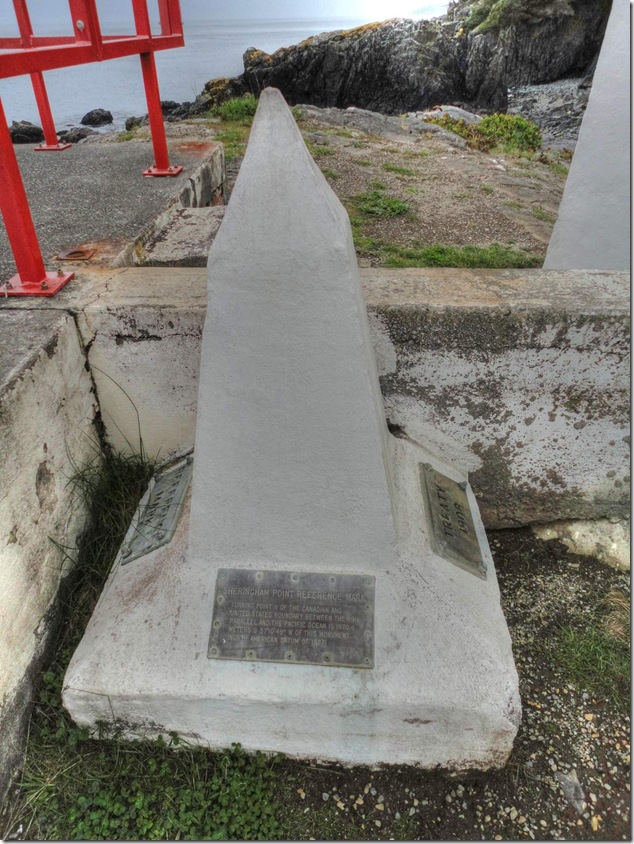
This monument was placed in 1908 when a treaty was signed and the International Boundary Commission (IBC) was formed, which was tasked with marking the boundary. In 1925, the IBC became a permanent agency and was tasked with maintaining the boundary markers and keeping the border visible.
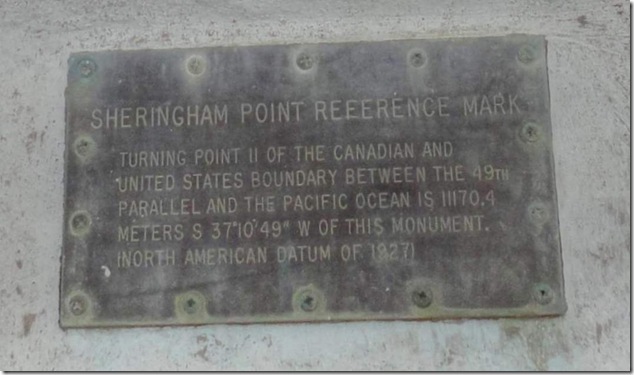
The border between Canada and the United States makes 12 turns between the 49th parallel and the Pacific Ocean as it winds its way around the southern tip of Vancouver Island. This monument is the Canadian reference mark for Turning Point 11, the second most westerly.
The line demarcating the border between Canada and United States along the Juan de Fuca Straight consists of 12 straight line courses, the ends of which are fixed by reference marks on the shore. There are 12 turning points located approximately in the middle of major channels – each turning point being referenced by 2 of the 21 established monuments. The monuments range from concrete markers to lighthouses, and each may reference more than one turning point.