
Alberni Pacific No.2 was built in 1912 for the Weist Logging Co., and operated as No. 1 in Port Alberni. Between 1918 and 1950, it was operated as Alberni Pacific Lumber Co., Ltd. #2, in Franklin River.
The Western Vancouver Island Industrial Heritage Society acquired the Lima 42 ton 2-truck Shay in 1984, and is currently restoring it.
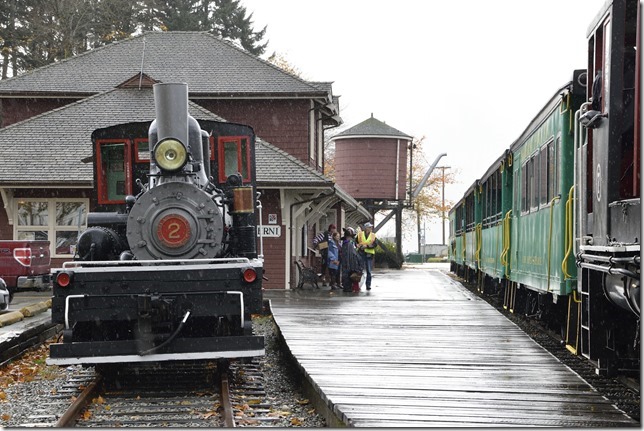
No.2 has a regular fire-tube boiler offset to the left to provide space for, and counterbalance the weight of, a two or three cylinder “motor,” mounted vertically on the right with longitudinal drive shafts extending fore and aft from the crankshaft at wheel axle height. The shafts have universal joints and square sliding prismatic joints to accommodate the swiveling trucks. Each axle was driven by a separate bevel gear, with no side rods.
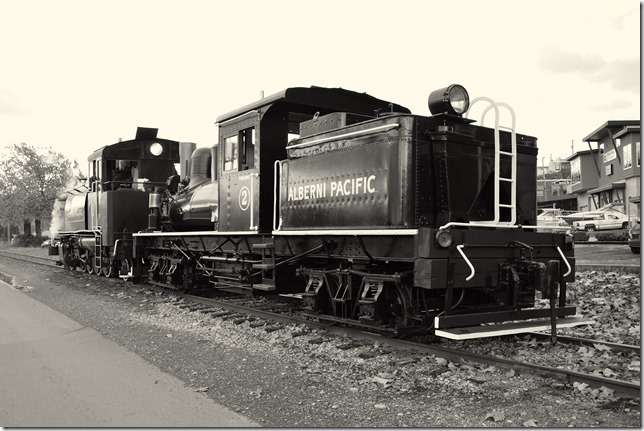
The strength of these engines is that all wheels, including, in some engines, those under the tender, are driven so that all the locomotive weight develops tractive effort.
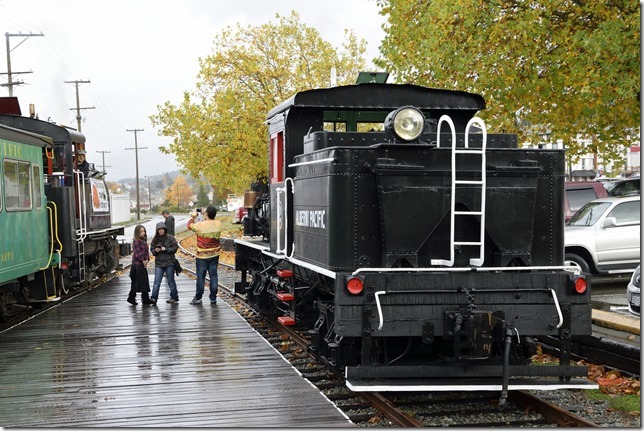
Lima utilized at least three types of smoke stacks on the Shay, each type serving a functional purpose related to type of fuel each particular locomotive was built to utilize.
The use of coal and wood posed a particular problem related to the exhaust of smoke through a smoke stack, as unlike oil, these fuels would not be totally consumed by the burning process and would leave a waste material behind referred to as ash and cinders. While most of the cinders would drop or settle out to the bottom of the boiler’s fire box, some were so small and light weight that the natural force of the exhaust of the smoke would carry them up and out of the smoke stack.
Once outside some cinders were still so hot that they glowed and could start a fire if they came in contact with dry combustible materials on the ground such as leaves, grass, and brush. Fire could also be a problem with nearby wooden structures such as bridges and buildings.

Alberni Pacific’s Shay has a straight through taper stack that does not contain cinder screens or baffles. Taper stacks were utilized on locomotives that burned oil, and some that burned coal in an environment where a fire from hot cinders would be a low probability.
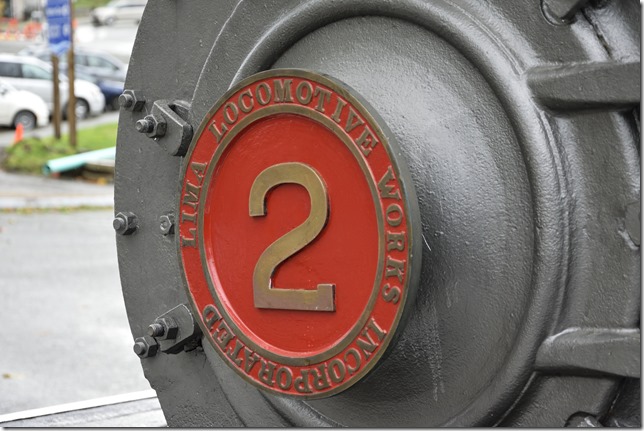
- Built: 28 June 1912, Lima Locomotive Works
- Builders No.: 2548 -1912
- Class: B (Balloon) 42-2 (3-cylinders/2-trucks/8 drivers)
- Trucks: 2
- Cylinders: (#-Diameter x Stroke) 3 – 10 x 12
- Gear Ratio: 2.05
- Wheel Diameter: 29.5″
- Gauge: Standard
- Boiler (Style – Diameter): E.W.T. – 42.125″
- Working Pressure: 180 psi
- Fuel Type: Wood/Coal/Oil
- Fuel Capacity: 1.5 Cords / 2 Tons
- Water Capacity: 1560 Gallons
- Empty Weight: As built 65,700 lbs
- Tractive Power: 16,900 pounds
- Hauling Capacity: 2,070 tons
- Length (cplr. – cplr.): 38’36”
And a bit of video…