
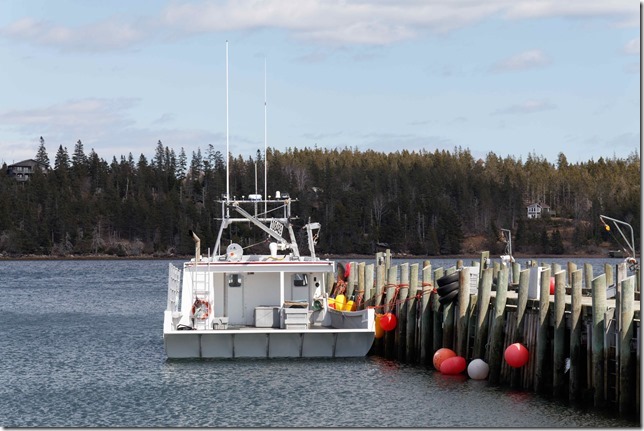
The fishing boat Briella Anne in Bayport
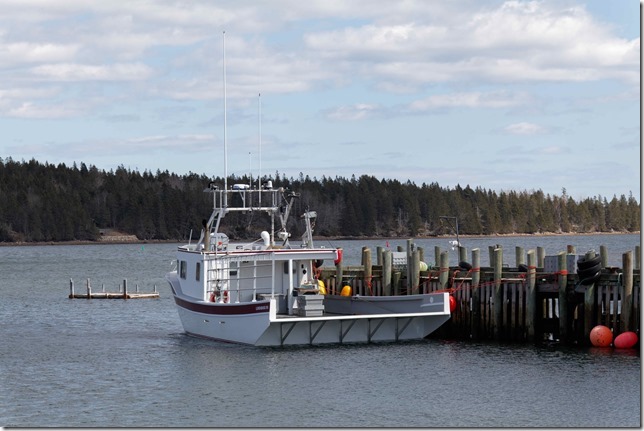
The fishing boat Briella Anne in Bayport
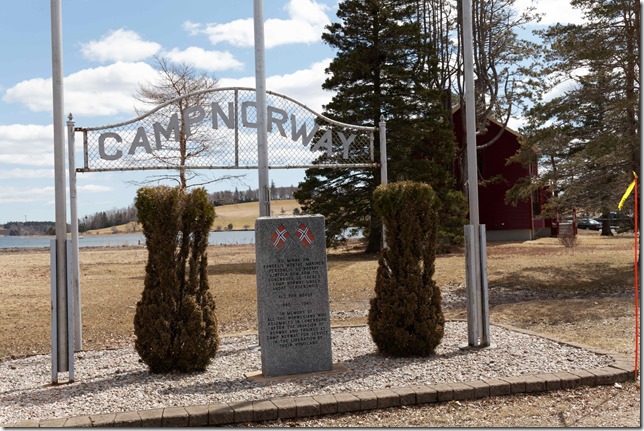
Camp Norway memorial, looking toward downtown Lunenburg
In 1940 Norway had the third largest ocean going merchant fleet in the world, with about 1100 ships. When Nazi Germany invaded the country on the 9th of April of that year, 1024 of those ships were at sea. The King immediately ordered them all to proceed to allied ports.
At the same time, the German-backed government that had been set up in Oslo under Vidkun Quisling, was broadcasting orders for the ships to return home. Not a single one did, and Norway’s great merchant fleet was now at the disposal of the Allies.
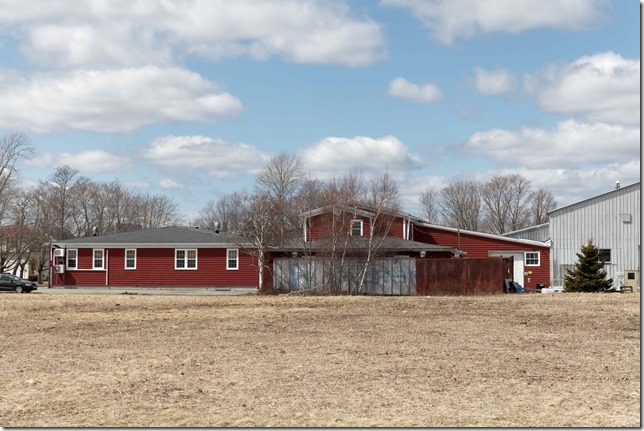
One of the remaining barracks
During the spring and summer of 1940, seven factory ships and 23 whale catchers with upwards of 2,000 men on board arrived in Halifax and anchored in Bedford Basin. After much negotiation, the ships were allowed to proceed to Lunenburg, and the Norwegian government was allowed to establish Camp Norway.
Camp Norway opened on Friday, Nov 29th, 1940, and consisted of barracks to house about 800 men. After the war ended, Camp Norway closed in 1945.
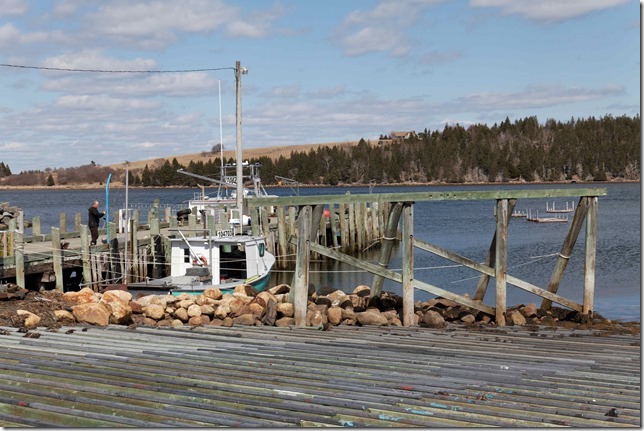
A quiet day at Bayport, looking over Lower South Cove toward Feltzen
You may know what the big white golf ball is if you live bear CFB Greenwood, but if you’re just traveling around the Annapolis Valley this large white object on Stronach Mountain might be a bit of a curiosity.
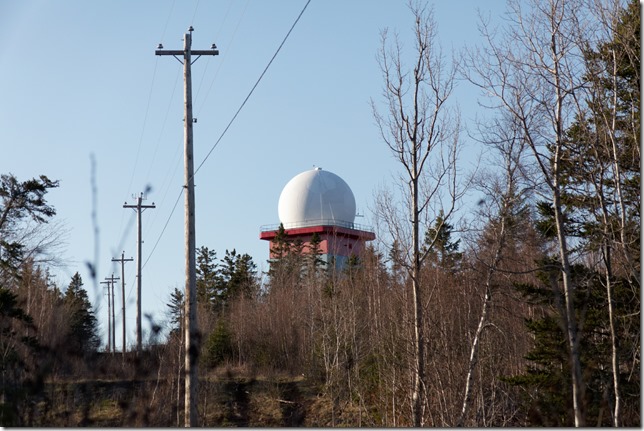
Area Surveillance Radar/Secondary Surveillance Radar (ASR/SSR)
While it looks like a huge golf ball, it’s actually a structure enclosing a radar antenna used to provide Air Traffic Management (ATM) services for the Military Terminal Control (MTC) centre at 14 Wing Greenwood.
The radar antenna is on a lattice steel tower approximately 20 to 30 m in height and supported on a concrete slab, measuring approximately 10 m x 10 m in size. The Radome (structure enclosing the radar antenna) is approximately 12 m in diameter situated on the lattice steel tower.
The Airbus Defence and Space supplied ASR-NG radar (Airport Surveillance Radar Next Generation) is used for approach control at the airfield itself and for airspace surveillance within a radius of 64 NM (110 km) to safely coordinate, amongst other things, military flight movements with civil air traffic.
The ASR-NG is combined with the MSSR 2000I (MSSR = Monopulse Secondary Surveillance Radar) secondary radar for automatic identification of individual aircraft. It meets the new air traffic control standards “Mode 5”, “Mode S” and “ADS-B”.
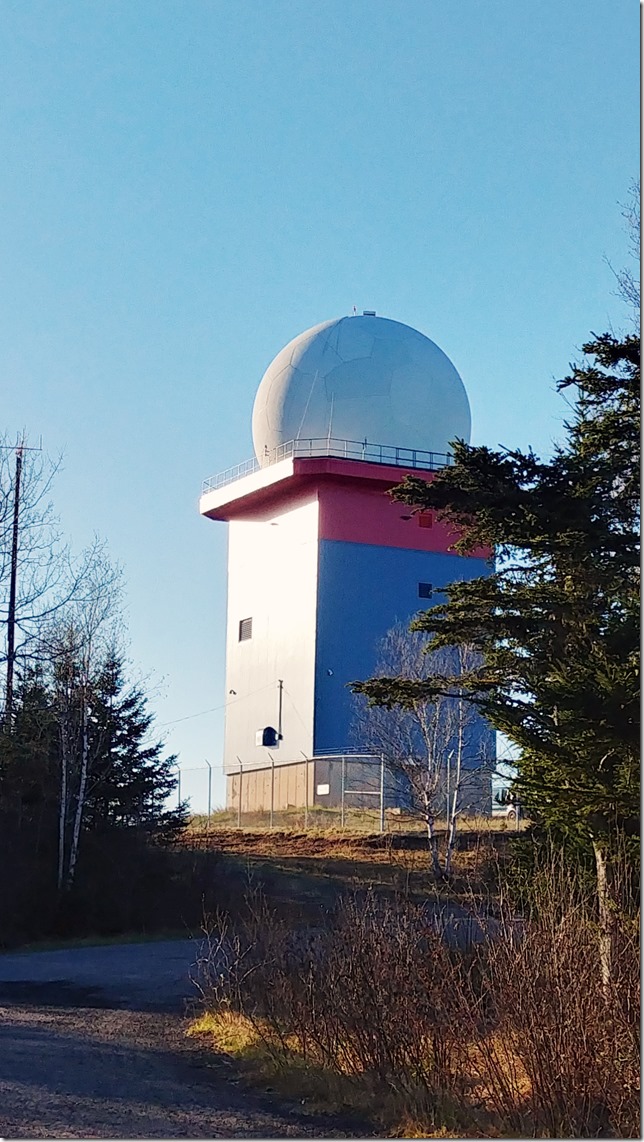
The Royal Canadian Air Force (RCAF) installed the seventh and final radar system associated with the Area Surveillance Radar/Secondary Surveillance Radar (ASR/SSR) project at 14 Wing Greenwood, Nova Scotia.
Announced in 2013, the project was mandated to replace the aging Terminal Radar and Control Systems (TRACS) with six new air traffic control systems and one training system. The old radar equipment was replaced at six sites: 3 Wing Bagotville, Quebec; 4 Wing Cold Lake, Alberta; 5 Wing Goose Bay, Newfoundland and Labrador; 8 Wing Trenton, Ontario; 14 Wing Greenwood, Nova Scotia; and 19 Wing Comox, British Columbia.
One additional radar system was delivered as a technical training suite (Aerospace Telecommunication Engineering Support Squadron – Trenton, Ontario.
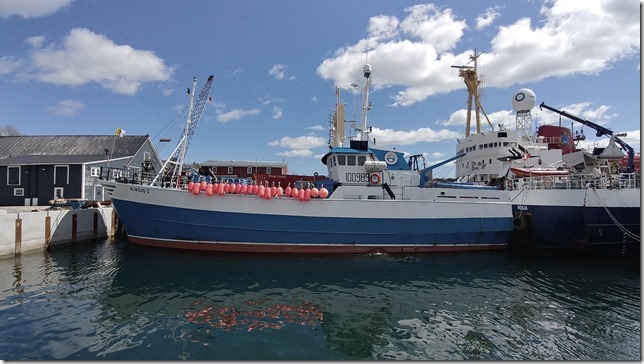
Kiviuq I in Lunenburg
Arctic Fisheries Alliances (AFA) owns and operates two 30 metre (99’) steel fixed-gear fishing vessels: the Suvak (ex Genny and Doug) and the Kiviuq. They are sister ships and are equipped with freezing-at-sea capabilities.
The Suvak operates in NAFO divisions 0A and 0B during the summer months, catching AFA’s Nunavut turbot quotas.
The Kiviuq conducts marine research and delivers supplies to AFA’s owner communities during the summer and fishes Atlantic halibut off Newfoundland on the Grand Banks in the winter.
AFA acquired a subsidiary company in 2015, called Arctic Fishery Alliance Inc. It is 100% owned by AFA LP and operates as a for-profit stand-alone company to manage the Kiviuq’s marine research activities.
AFA is Nunavut’s first 100% Inuit owned fishing enterprise.
The story does not end here…
Genny and Doug, hull#223 , official number 808234 was built for
Jonathan & Amy Fish, and later renamed Suvak.
Atlantic Prospect, hull# 224, official number 808647 was built for Pierce Fisheries Ltd, and later renamed Tulugarnaq, and now Kiviuq I
The shipyard in Pictou was originally called Pictou Iron Foundry & Machine Shop and dated from the establishment of a marine railway at this site in 1851. A World War II emergency shipyard was initially started under their management, but Foundation Maritime took over almost immediately and operated the yard until the end of the war.
This allowed Pictou to concentrate on urgent repair work. Pictou Foundry took over the yard at the end of the war and continued shipbuilding, starting a new hull list at #101. The firm was renamed Ferguson Industries Ltd in 1952, Pictou Industries Ltd in 1986 and continued to operate until 1993.
It was acquired by Aecon in 2008 and reactivated, with considerable capital investment, as Aecon Atlantic Industrial, Inc.

It has been a while since I posted a reflective self portrait, so here we are with one that I shot at a very interesting place – the Church Grove Cemetery Company.
In 1851, Rev. Robert Stewart came from Ireland to the community of Wilmot and Melvern Square, preaching in the local schoolhouse. In 1853-54 the Covenanter Congregation was officially organized and David Cruikshanks and Daniel Morrison were named elders.

The church building was completed in 1855. In 1878, Rev. Stewart while keeping his home in Melvern Square, travelled to the United States and joined the Presbyterian Church. In 1892 he rejoined the Covenanter Church and returned to Melvern Square. His home congregation would not stay Covenanters much longer and they joined the Presbyterian Church of Canada in 1893. The Presbyterians in this part of the valley were eventually absorbed into other congregations and the Covenanter Church was no longer in use.

The little white church became part of the Melvern Square Cemetery Company and in 1976 it was renamed the Church Grove Cemetery Company.

Melvern Square United Baptist Church – Stronach Mountain Road

One of the abandoned houses of Nova Scotia – Annapolis Valley

A Centurion Main Battle Tank Mk. 5 at the former CFB Cornwallis in Deep Brook, Nova Scotia. The Mk. 5 carried a type A barrel 20-pounder (84mm) main gun.
