M/V Bowen Queen

The Bowen Queen is one of three Powell River Class ferries operated by BC Ferries.

BC Ferries,Bowen Queen,Powell River Class

  • Built: 1965, Victoria Machinery Depot Co. Victoria BC
  • Launched: November 15, 1965
  • Overall Length: 84.96 m
  • Breadth: 18.7 m
  • Gross Tons: 1,475.68
  • Dead Weight: 515 tons
  • Draught: 3.3 m
  • Maximum Displacement: 1637 tonnes
  • Car Capacity: 70
  • Passenger & Crew Capacity: 400
  • 4 Caterpillar diesel engines, 900 BHP each,
  • 4 azimuth turning right angle drive propellers
  • Maximum Speed: 14.5 knots
Posted in Georgia Strait, Gulf Islands, ships, tourism, Vancouver Island Images | Tagged , , | Leave a comment

CCGS Cape Cockburn

The CCGS Cape Cockburn is one of the Canadian Coast Guard’s 36 Cape class motor life boats. Her primary role is search and rescue.

  • Builder: Victoria Shipyard Ltd., Victoria, British Columbia
  • Year Launched: 2003
  • Tonnage gross: 33.8 tons
  • Tonnage net: 25.3 tons
  • Length: 14.6 m (47 ft 11 in)
  • Beam: 4.27 m (14 ft 0 in)
  • Draft: 1.37 m (4 ft 6 in)
  • Propulsion: 2 × Caterpillar 3196 diesel electric engines, 675 kW
  • Propellers:  Fixed Pitch x 2
  • Cruising Speed: 22.0 kts
  • Maximum Speed: 25.0 kts
  • Range: 200 nmi (370 km)
  • Class of Voyage: Near Coastal – up to 200nm
  • Cruising Range: 200 nm
  • Endurance: 1 day
  • Complement: 4

Electronics:

  • VHF AM: Bendix-King KY196 x 1
  • VHF FM: Ross DSC 500 x 1
  • VHF FM: Icom IC-M502
  • VHF FM: Motorola Astro Spectra x 1
  • HF: Motorola Micom x 1
  • SatComms: Sailor SC4000 Iridium x 1
  • Gyro: Anschutz Gyrostar II x 1
  • Radar: Raymarine E Series – X Band
  • Electronic Charts: ICAN Aldebaran II x 1
  • Auto Pilot: Comnav 2001 x 1
  • GPS: SAAB R4 x 1
  • VHF DF: OAR Cubic DF4400
  • Depth Sounders #1: Si-Tex Koden CVS 108
  • Depth Sounders #2: Datamarine 3000
  • Depth Sounders #3: Raymarine ST70
Posted in ships, Vancouver Island, Vancouver Island Images | Tagged , , , , , | Leave a comment

CCGS Neocaligus

Nearshore Fishery Research Vessel CCGS Neocaligus at Mayne Island. 

CCGS Neocaligus,Mayne Island

Neocaligus is based out of Patricia Bay, and is used primarily for inshore fisheries research.

  • Builder: Shore Boat Builders Ltd., Richmond, British Columbia
  • Year Launched: 1989
  • Year in Service: 2001
  • Length: 18.8 m
  • Breadth: 6.7 m
  • Draught: 3.5m
  • Gross Tonnage: 98.5 tons
  • Net Tonnage: 48.3 tons
  • Cruising Speed: 11.0 kts
  • Propulsion: Geared Diesel
  • Engine #1: Caterpillar 3412 x 1
  • Propellers:  Controllable Pitch x 1
  • Complement: 4 Officers: 2 Crew: 2
  • Gyro: Anschutz Standard 20 x 1
  • VHF FM: Marconi x 1
  • Electronic Charts: ICAN Aldebaran II x 1
  • Auto Pilot: Comnav 2001 x 1
  • GPS: SAAB R4 x 1
Posted in Gulf Islands, marina, ships, Vancouver Island Images | Tagged , , , | Leave a comment

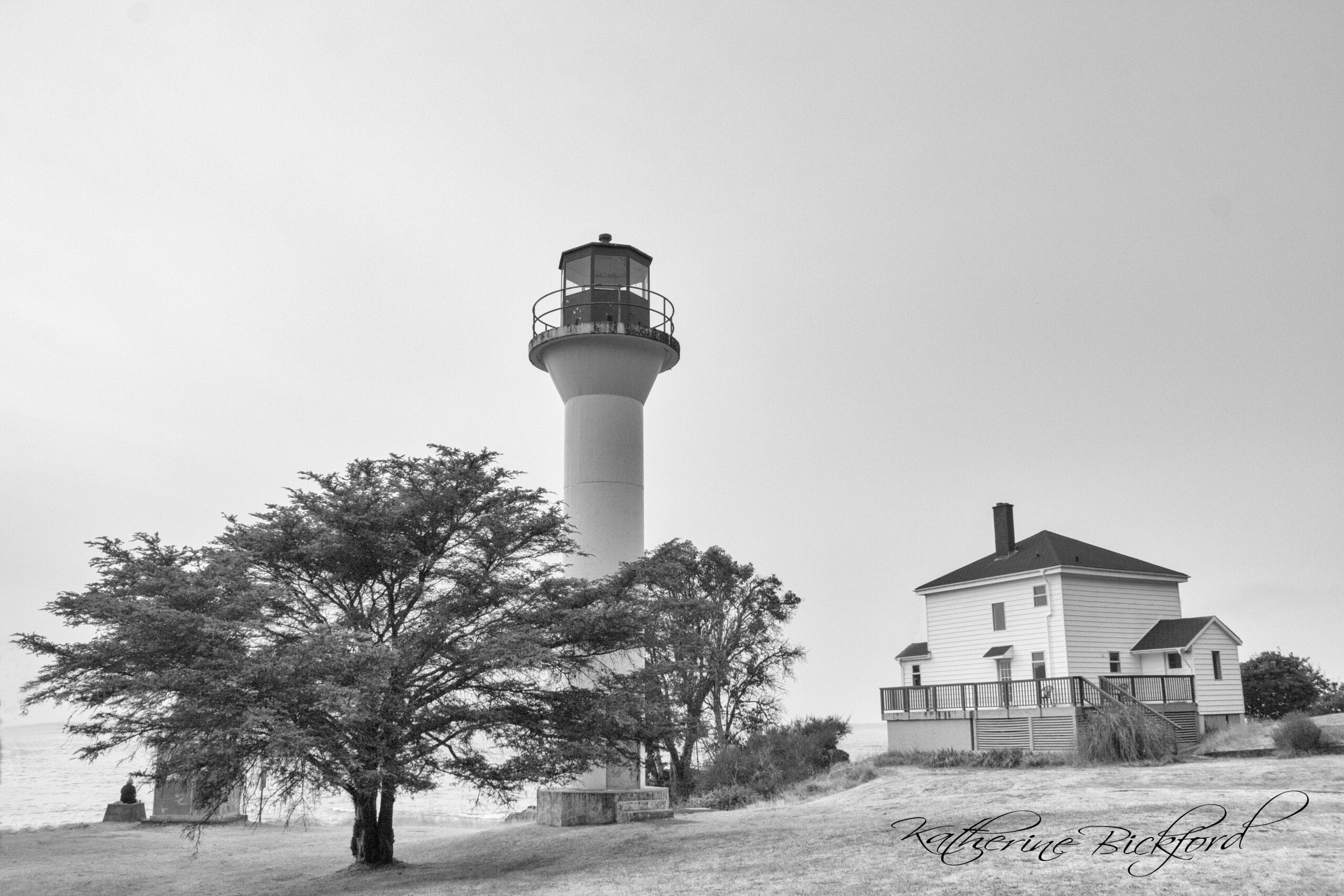
Georgina Point lighthouse

The Active Pass Light Station lighthouse Georgina Point on the northern tip of Mayne Island marks the entrance to Active Pass. Part of the Gulf Islands National Park Reserve, Georgina Point is located between Maude Bay and Oyster Bay.

The light station was built in 1885 to warn ships of the reefs and rough waters of Active Pass. The original 1885 lighthouse was replaced in 1940 by a square keeper’s dwelling surmounted by a lantern room. In 1969, a cylindrical concrete structure topped by a lantern and galley was constructed to serve as the lighthouse, but the square dwelling was retained to house the keeper. The modern tower has a focal plane of 17.5 metres and flashes a white light every ten seconds. The light can be seen up to 17 nautical miles away.

Active Pass Light Station fell victim to the de-staffing movement when its last keeper, Jean Beaudet, left the station in 1997. Ownership of the property was transferred to the Gulf Islands National Park Reserve in 2006, while the Canadian Coast Guard still has responsibility for the navigational aids.

Posted in Georgia Strait, Gulf Islands, lighthouse, Vancouver Island Images | Tagged , , , , | Leave a comment

Queen of Burnaby

The Queen of Burnaby crossing Georgia Strait from Powell River as she heads into the BC Ferries terminal at Little River, near Comox on Vancouver Island.

Queen of Burnaby,Georgia Strait,Powell River,BC Ferries, Little River,Comox

I never tire of these beautiful ships…

Queen of Burnaby,Georgia Strait,Powell River,BC Ferries, Little River,Comox

Posted in Georgia Strait, Little River, ocean, ships, Vancouver Island, Vancouver Island Images | Tagged , , , , , | Leave a comment

Comox marina at night

I’ve always enjoyed fishing boats and the sights and sounds of a marina, so I headed down to the Comox marina at night to take some pictures – in December…

Comox,marina,exisiting light photography Comox,marina,exisiting light photography marcmoxni-03 Comox,marina,exisiting light photography Comox,marina,exisiting light photography Comox,marina,exisiting light photography

Posted in fishing boats, marina, ships, Vancouver Island, Vancouver Island Images | Leave a comment

HMCS Calgary

HMCS Calgary (FFH 335) is a Halifax-class frigate, the sixth vessel in her class and the second vessel to carry the name Calgary. Built as part of the Canadian Patrol Frigate Project., Calgary was laid down on 15 June 1991 at MIL Davie Shipbuilding, Lauzon, QC, and launched on 28 August 1992. She was commissioned into on 12 May 1995.

On 6 June 2011 Calgary was turned over to Seaspan Marine Corporation’s Victoria Shipyards to start a 18 month mid-life upgrading and modernization. Calgary was returned to the RCN from Victoria Shipyards on 1 June 2012 and as of fall 2013 is conducting sea acceptance trials.

HMCS Calgary,FFH 335,Canadian Patrol Frigate Project,Halifax class,Navy,RCN,Nanoose

Motto: “Onward”

  • Displacement: 3,995 tonnes (light). 4,795 tonnes (operational)
  • Displacement: 5,032 tonnes (deep load)
  • Length: 134.2 m
  • Beam: 16.5 m
  • Draught: 7.1 m
  • Range: 9,500 nautical miles (17,600 km)
  • Complement: 225 (including air detachment)

Propulsion:

  • 2 × LM2500 Gas turbines, 1 × SEMT Pielstick Diesel engine
  • 1 × Royal de Schelde cross-connect gearbox
  • 2 × Escher Wyss controllable pitch propellers
  • 4 × 850kW AEG Telefunken generators
  • Speed: 30 knots (56 km/h)

        HMCS Calgary,FFH 335,Canadian Patrol Frigate Project,Halifax class

        Sensors:

        • Ericsson Sea Giraffe HC 150 Air/Surface Search:
        • AN/SPS-49(V)5 Long Range Air Search
        • SPG-503 STIR 1.8 Fire Control 
        • AN/SQS-510 Active Sonar
        • AN/SQR-501 CANTASS Passive Sonar
        • SLQ-501 CANEWS (Canadian Electronic Warfare System)
        • SLQ-505 radar jammer
        • Kelvin Hughes Type 1007 I-band navigation radar

        Armament:

        • 24 × Honeywell Mk 46 torpedoes
        • 16 × RIM-162 Evolved Sea-Sparrow SAM
        • 8 × RGM-84 Harpoon SSM
        • 1 × 57 mm Bofors Mk2 gun
        • 1 × 20 mm Vulcan Phalanx CIWS
        • TKWA/MASS (Multi Ammunition Softkill System)
        • 6 × .50 Calibre machine guns
        • Aircraft carried: 1 × CH-124 Sea King

        • Posted in history, Nanoose, Navy, RCN, Vancouver Island, Vancouver Island Images, video | Tagged , , , , , , | Leave a comment

          The dead jetties

          Nanoose Bay has a long been home to the the Nanoose First Nation (Snaw-Naw-As), who along with 18 other tribes in the Salish Sea are Coast Salish people.

          Nanoose,harbour,history,Vancouver Island,abandonded,marina,CFMETR

          It’s also been home to marinas, and aquaculture, a large lumber mill, and currently the Canadian Forces Maritime Experimental Test Range (CFMETR).

          Nanoose,harbour,history,Vancouver Island,abandonded,marina,CFMETR 

          There’s a bit of history here:

          • 1951: The land for the CFMETR base at Nanoose Bay is expropriated by the federal government in 1951.
          • 1965: Canada and the United States agreed upon the establishment, operation and maintenance of a torpedo test range at Nanoose Bay in the Strait of Georgia.
          • 1967: The Supreme Court of Canada considered a reference to determine whether the seabed within the three-mile limit of the west coast territorial sea, and the associated mineral resources, were owned by the Province of British Columbia or Canada. The Supreme Court held that Canada had both jurisdiction over and property rights in the territorial sea, from the low-water mark of the province to the territorial boundary recognized by international law.
          • 1984: British Columbia claimed that the historical documentation surrounding the establishment of the province proved that certain bodies of water, and the seabed beneath them, had in fact been within the boundaries of the province at Confederation, and were therefore still the property of the province. The Supreme Court of Canada finds that the Province of British Columbia still had ownership of the seabed of the Strait of Georgia.
          • 1988: The foreshore was transferred to Canada by British Columbia in 1988, for military use over a period of 60 years.
          • 1989: The federal and provincial governments signed a ten-year “licence of occupation” under the British Columbia Land Act.
          • 1996: The Federal Court rejected a SPEC challenge of a decision by then Environment Minister Sheila Copps to exempt US warships from Canadian environmental regulations that prohibit the dumping of toxic materials into fish bearing waters.
          • 1997:  The British Columbia government gave notice that it would terminate the licence, because it was not satisfied with the progress of Canada-U.S. negotiations on the Pacific Salmon Treaty.  The Government of Canada initiates a court challenge in the Superior Court of British Columbia to prevent an early termination of the agreement with the Government of British Columbia.
          • 1999: The government of Canada announced that it had begun the process of expropriating the seabed at CFMETR.
          • 2002: Federal Court Justice Douglas Campbell had ruled in favour of an appeal by the Society Promoting Environmental Conservation and overturned the 1999 expropriation. Campbell decided that the officer in charge of the expropriation hearings had not given sufficient notice to a significant number of citizens groups and individuals to make presentations at the public hearing.
          • 2003: The Federal Court of Appeal reverses the Federal Court decision that had overturned the 1999 expropriation of the Nanoose torpedo test range near Nanaimo.

          Nanoose,harbour,history,Vancouver Island,abandonded,marina,CFMETR

          And today… there is not much that remains.

          Nanoose,harbour,history,Vancouver Island,abandonded,marina,CFMETR

          Posted in abandoned, Georgia Strait, history, marina, Nanoose, ocean, Vancouver Island, Vancouver Island Images | Tagged , , , , , , | Leave a comment

          Alberni Pacific No. 7

          In 1912, Port Alberni was incorporated with the arrival of the Esquimalt and Nanaimo Railway, and planned arrival of the Canadian National Railway, and the trans-Pacific telegraph cable at Bamfield. The Alberni Pacific railway began operations in 1912 into Port Alberni, and today, exists as a working tourist railway running between the station located at the Port Alberni harbour and the McLean Mill National Historic Site.

          Baldwin,Port Alberni,steam locomotive,Mikado,Alberni Pacific,logging railroad

          I managed to get a ride aboard a train pulled by the railways 1929 Baldwin 2-8-2T, the “No.7”.

          This locomotive was purchased new by the Campbell River Timber company as their #2 and was later purchased by the Alberni Pacific Lumber company and became #7 . After Alberni Pacific abandoned railway logging in 1953, #7 was acquired by MacMillan Bloedel and became #1007 at the Franklin River division.

          Baldwin,Port Alberni,steam locomotive,Mikado,Alberni Pacific,logging railroad

          Renumbered as #1055 the locomotive saw mainline service in Ladysmith until 1969 and as a switcher until 1971. The BC government acquired the locomotive in 1975 and kept it in storage at Ladysmith until In 1991, when it was donated to The City of Port Alberni and subsequently restored to running condition.

          Under the Whyte notation for the classification of steam locomotives, 2-8-2 represents the wheel arrangement of two leading wheels on one axle,  eight powered and coupled driving wheels on four axles, and two trailing wheels on one axle. The notation 2-8-2T indicates a tank locomotive of this wheel arrangement where feed water for the boiler is carried in tanks mounted on the locomotive, rather than in an attached tender. These locomotives are commonly referred to as Mikados.

          The Canadian National Railway and the  Canadian Pacific used Mikado locomotives for passenger and freight trains throughout Canada. Most worked in the Rocky Mountains, where the standard 4-6-2 Pacifics and 4-6-4 Hudsons could not provide enough traction to handle the steep mountain grades.

          Baldwin,Port Alberni,steam locomotive,Mikado,Alberni Pacific,logging railroad

          Baldwin Locomotive Works was an American builder of railroad (railway) locomotives. Although the company was very successful as a producer of steam locomotives, its transition to the production of diesels was far less so – the company stopped producing locomotives in 1956 and went out of business in 1972.


          • No: 7 (1055)
          • Built as: Baldwin #60942
          • Built: 1929
          • Weight: 90 tons
          • Classification: 2-8-2T
          • Gauge: 4′-8½”
          • Length overall: 36’10”
          • Operated by: Alberni Pacific Lumber (M-B)

          Posted in history, Port Alberni, rail, tourism, trains, Vancouver Island, Vancouver Island Images, video, winter | Tagged , , , , , | Leave a comment

          Top Bridge suspension bridge

          A quick stop at Top Bridge to visit the suspension bridge over the Englishman River near Parksville. The water was low so I took the side trail down to the river to look for some nice dead salmon that had yet to be eaten by a bear, bird or cougar. and of course to take a few pictures of the river and the bridge.

          Top Bridge,Englishman River,suspension bridge,parksville

          I had a bear bell and bear spray with me as this is borderline back county, and salmon are a tasty and important food source for bears and other animals that would likely want to eat me as well if I came between them and supper. What I did not have though was a polarizing filter.

          Top Bridge,Englishman River,suspension bridge,parksville

          Bright sun streaming through broken cloud onto water. Nasty, but I was there and got a few so-so shots despite the lack of the polarizer and a few other tricks that I should have had with me.

          Top Bridge,Englishman River,suspension bridge,parksville

          At least I did not get eaten or washed down the river…

          Top Bridge,Englishman River,suspension bridge,parksville

          Posted in bridges, hiking, nature, Parksville, Vancouver Island, Vancouver Island Images, waterfall | Tagged , , , , | Leave a comment